
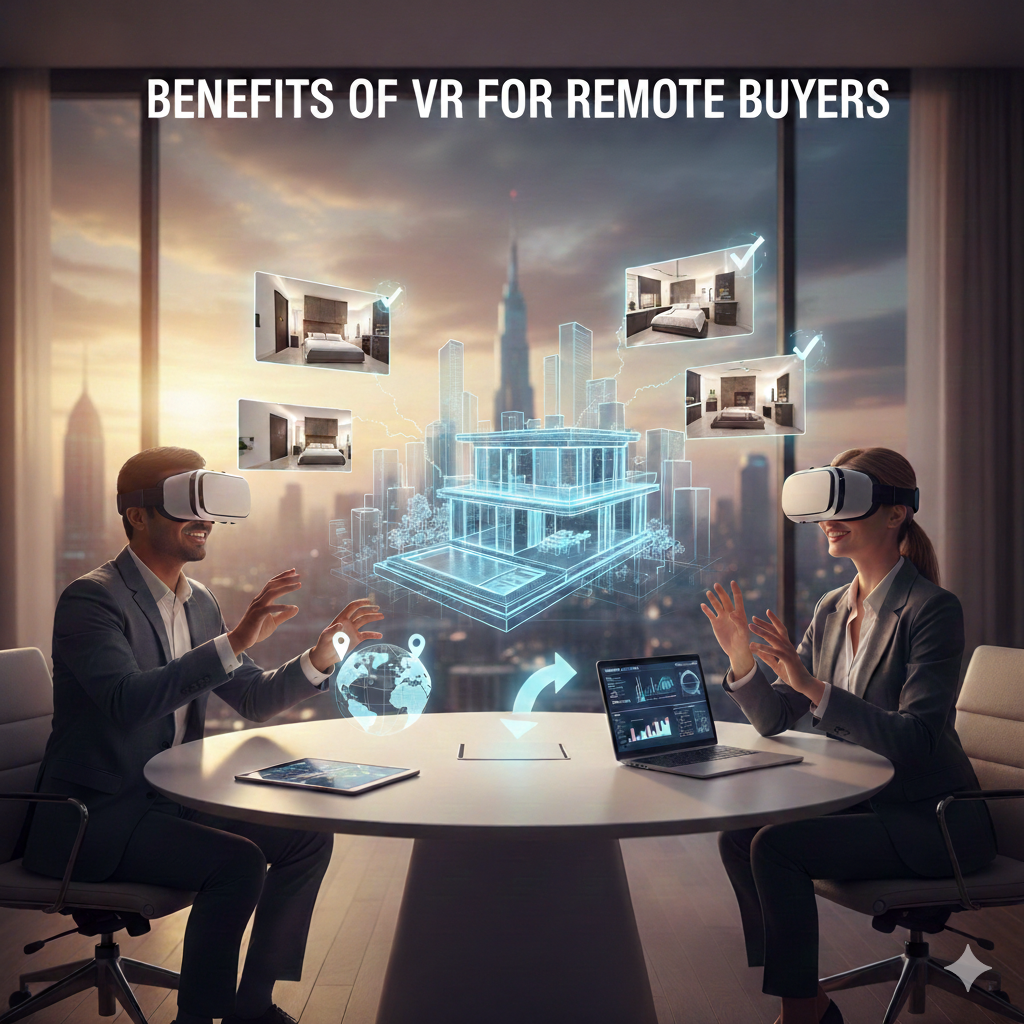
Buying or approving a space without visiting it in person has always been challenging. Even with high-quality photos, videos, and floor plans, buyers are often left with unanswered questions. Does the space feel open or cramped? Is the layout practical? Will the final outcome match what is being promised?
For remote buyers whether they are in another city or another country this uncertainty can slow down decisions or stop them entirely. This is where Virtual Reality (VR) is transforming the buying experience by offering clarity, confidence, and realism from anywhere in the world.
How Virtual Reality Helps Remote Buyers
Virtual Reality allows buyers to explore a space digitally as if they were physically present inside it. Instead of relying on imagination, buyers can walk through rooms, understand proportions, and experience how a space flows from one area to another. This immersive experience helps remote buyers feel more connected to what they are evaluating.
Unlike traditional visuals, VR provides a realistic sense of scale and depth. Buyers can understand room sizes, ceiling heights, and spatial relationships in a way that photos or videos simply cannot capture. This makes it easier to visualise the final outcome and evaluate whether a space truly meets their needs.
Faster Decisions with Greater Confidence
One of the biggest advantages of VR for remote buyers is confidence. When buyers can clearly understand what they are investing in, hesitation is reduced. VR removes much of the uncertainty that comes with long-distance decision-making, helping buyers move forward faster, even for high-value purchases.
This is especially useful for international buyers, NRIs, investors, and corporate decision-makers who may not have the time or flexibility to travel frequently. VR acts as a realistic alternative to physical walkthroughs, allowing them to explore spaces thoroughly without being on site.
Fewer Site Visits, Better Use of Time
Virtual Reality also helps reduce the need for multiple site visits. Buyers can shortlist and evaluate options remotely, ensuring that any physical visits, if required, are more focused and purposeful. This saves time for both buyers and businesses while making the overall process more efficient.
Another important benefit is access to projects before they are completed. VR allows buyers to explore spaces that are under construction or yet to be built. By visualising the final design early, buyers can engage with projects sooner and make informed decisions at an earlier stage.
Where VR Makes the Biggest Impact
VR is proving especially valuable in industries such as real estate, hospitality, commercial spaces, architecture, interior design, and large infrastructure projects. In all these sectors, remote buyers need clarity before committing, and immersive experiences help bridge the gap between distance and decision-making.
From a business perspective, VR expands reach beyond local markets, shortens sales cycles, improves buyer confidence, and strengthens brand credibility. It is no longer just a convenience it is a strategic advantage for businesses working with remote audiences.
Final Thoughts
For remote buyers, clarity and trust are essential. Virtual Reality helps bridge the distance between viewing and deciding by allowing people to truly experience spaces rather than just look at them on a screen. When buyers can understand layout, scale, and flow in a realistic way, decisions become easier and more informed.
Thoughtfully designed VR experiences benefit both buyers and businesses by reducing uncertainty, saving time, and improving engagement with serious prospects. At MagicalXR, VR solutions are built with this practical purpose in mind focusing on accuracy, ease of use, and real-world application. By creating immersive experiences that feel intuitive and reliable, MagicalXR helps businesses connect more effectively with remote buyers and support confident decision-making.
As remote buying continues to grow, Virtual Reality is becoming an essential part of how spaces are explored, understood, and trusted no matter where buyers are located.
.